
Daily Living Skills Made Easier: For Autistic and ADHD Adults
Do you forget appointments the moment you make them? Does making a phone call feel like climbing a mountain? Do you stare at a task you know you need to do and still can't make yourself start? If any of that sounds familiar, this guide is for you.
Struggling with these things doesn't mean you're lazy. For autistic and ADHD adults, these daily challenges are often rooted in something neurological - executive functioning differences in the brain. Research confirms that executive dysfunction is a consistent, well documented feature of neurodivergent brains. Executive functioning is the brain's control center, it manages planning, organizing, starting tasks, and managing time. When your brain is wired differently, the "simple" stuff rarely feels simple.
The good news? When you understand why your brain works the way it does, you can start building systems and strategies that actually work. This guide covers 8 of the most common areas where autistic and ADHD adults get stuck and more importantly, what you can actually do about them.
What You Will Learn
- ADHD-friendly budgeting strategies
- Simple ways to make and manage appointments
- Strategies to remember your schedule
- Neurodivergent time management strategies
- How to start tasks (even when it’s hard)
- Simple planning and organizing tools
- How to advocate for yourself
- Daily life skills made easier
1. Budgeting Money: Simple Systems That Actually Work

Budgeting is not just about being 'responsible with money.' For autistic and ADHD adults, managing money is a genuine executive functioning challenge. Working memory makes it hard to track what you've spent. Impulsivity can lead to unplanned purchases and time blindness means bills sneak up on you. A budget gives you a clear picture of where your money is going and what you have left.
Start with one simple rule: know your three numbers. Your income (what comes in), your fixed costs (rent, phone, subscriptions), and what's left. That leftover amount is what you actually have to spend freely.
There are many free apps that can help you manage your money and give you visual, color-coded breakdowns. Many autistic and ADHD adults find these tools game-changing because they remove the need to hold financial information in your head. Set up automatic payments for fixed bills so they don't require remembering.
If you receive disability benefits, look into ABLE accounts, tax-free savings accounts designed for people with disabilities that do not affect most benefit programs.
📊 Real Talk: Autistic adults face significantly higher rates of unemployment and financial stress compared to the general population. Building money management skills early creates a safety net that matters enormously, whatever your employment path looks like.
Practical Strategy:
Create three envelopes (physical or digital) labeled Bills, Food, and Fun. Divide your money every time you get paid.
Resources:
- Budgeting apps or even a simple color-coded spreadsheet
- The Consumer Financial Protection Bureau (CFPB) has free tools and guides at consumerfinance.gov
2. How to Set Up Appointments: Navigating Phone Calls and Scheduling
Picking up the phone to make an appointment is one of the most anxiety-inducing tasks for many autistic and neurotypical adults. Phone calls require real-time processing, social scripts, and juggling information on the fly, all things that executive dysfunction makes significantly harder.
First, know that you have options. Many clinics, therapists, and services now allow you to book online or via a patient portal. Always look for the online booking option first. If you must call, write out a short script before you dial. For example: 'Hi, my name is [Name]. I'd like to make an appointment with Dr. [Name]. I'm a new patient. What times do you have available?'
Practice the script out loud before calling. This reduces the cognitive load during the actual call because your brain isn't creating the words and processing responses at the same time.
It is completely okay to ask for accommodations. You can say: 'I have a disability and do better with written communication. Is there a way to book online or via email?' This is a reasonable adjustment that most providers are willing to make.
💡 Pro Tip: Online booking services and patient portals are increasingly common. Search '[business name] online booking' before picking up the phone, it may save you a lot of anxiety.
Practical Strategies:
- Write your script before calling. Keep it by the phone.
- Look for online booking portals first, many now offer this option.
- If you freeze mid-call, it's okay to say: 'Can you hold on one moment?' and take a breath.
3. How to Remember Appointments and Schedules:
Here is the truth: relying on your brain to remember appointments is setting yourself up to fail. This is not a personal flaw. Working memory challenges are a core feature of both autism and ADHD, as confirmed by multiple peer-reviewed studies. External memory systems are not a crutch, they are the actual solution.
The moment an appointment is made, it needs to go somewhere outside your head. Immediately. Right then. Whether that's a phone calendar, a paper planner, or a sticky note on your mirror. Pick one system and commit to it.
Google Calendar is a top choice because it sends you reminders at multiple intervals. Set reminders for 1 week before, 1 day before, and 1 hour before. That triple layer means even if you miss one alert, you still have backup.
For parents supporting a young adult with autism or ADHD, help them build this habit while they're still at home. Practice entering appointments together so it becomes automatic before they're on their own.
🧠 Brain Science: Research confirms that autistic and ADHD brains show consistent working memory challenges. External systems are not compensation, they are the evidence-based strategy. Using a calendar is what neurotypical adults with great executive function do too.
Practical Strategies:
- Use Google Calendar or another online calendar with layered reminders (1 week, 1 day, 1 hour before).
- Put a whiteboard calendar somewhere visible in your home for appointments in the next 30 days.
- Apps to try: Most phones have built in reminder apps but you can also use Notion or Google Tasks (both free).
4. Time Management: Making Time Visible

'Time blindness' is a term coined by ADHD researcher Dr. Russell Barkley, who described it as 'the ultimate, yet nearly invisible, disability afflicting those with ADHD'. Research also shows that altered time perception is a central symptom in adults with ADHD and this resonates deeply with many autistic adults as well. Time blindness means that instead of sensing time as a continuous flow, you only experience two time zones: 'now' and 'not now.' This makes it incredibly hard to plan ahead, transition between tasks, or arrive anywhere on time.
The most effective strategy for time blindness is making time visible. Analog clocks, visual timers, and time-blocking apps all serve the same purpose: they turn an invisible concept into something your eyes can see and track.
Time-blocking means scheduling specific activities into specific time slots in your day. Instead of a long to-do list floating in space with no clear start time, every task gets a dedicated hour in your day.This is especially helpful for neurodivergent adults because it removes the constant decision-making of 'what do I do next?'
Physical Time Timer clocks or countdown timers on YouTube are specifically popular in the autistic and ADHD community because they show time shrinking visually, like a pie slice disappearing.
⏰ Try This Today: Set a visual timer for your next task. Place it somewhere you can see it easily. Notice whether having a visible countdown changes how you experience that block of time.
Practical Strategies:
- Use a visible timer/clock
- Try time-blocking your day the night before using Google Calendar or a paper planner.
- Give yourself a 'transition buffer’ - extra time between activities to avoid rushing.
5. Task Initiation: Getting Started When It Feels Impossible
Task initiation is one of the most misunderstood executive functioning challenges. From the outside, it looks like laziness or procrastination. From the inside, it feels like standing at the edge of a pool, knowing you need to jump, and your body simply refusing to move.
Research confirms that people with ADHD and autism tend to struggle specifically with initiating tasks, especially tasks that are unpleasant, ambiguous, or large. ADHD is fundamentally a performance disorder - people know what they need to do but struggle to transform intention into action. The brain's dopamine system, which drives motivation and task-starting, functions differently in neurodivergent brains.
Don't wait to feel motivated, instead make the first step so small your brain can't say no. Once you start, it gets easier. For example, instead of telling yourself to 'do your homework,' just get the notebook out. That's it. Once it's in front of you, starting feels a lot less overwhelming.
Practical Strategies:
- Body doubling is one of the most effective strategies for task initiation. There are virtual co-working communities that connect you with a partner who works silently alongside you online. Many autistic and ADHD adults find this dramatically improves their ability to start and sustain tasks. Focusmate.com offers free and paid sessions with a virtual accountability partner.
- Try the 2-minute rule: if it takes less than 2 minutes, do it right now.
- Break tasks into micro steps and write out the very first action: not 'do laundry' but 'pick up one piece of clothing.'
6. Planning and Organizing: Building Systems That Your Brain Can Follow

Planning and organizing are executive functioning skills that require your brain to hold a future goal in mind while arranging current steps to get there. A visual plan gives your brain a clear roadmap for what’s to come. For autistic and ADHD adults this process often becomes difficult when it comes to sequencing tasks and deciding what to do first. Using the right external tools can help structure those steps and take pressure off your working memory.
The solution is externalization. Get the plan out of your head and onto paper, a whiteboard, or an app. Mind mapping is one method that works especially well for visual thinkers, it lets you dump all your ideas and then connect them into an order that makes sense.
For everyday life, a weekly reset routine is a powerful organizing tool. Set aside 20–30 minutes every Sunday (or whatever day works for you) to review the coming week: check appointments, prep meals, restock supplies, and confirm any commitments. This single habit can dramatically reduce the number of last minute surprises that dysregulate the nervous system.
For parents: help your young adult practice this routine before they leave home. Make it a regular shared activity so it becomes a familiar habit, not a novel one they have to figure out alone in adulthood.
🗂️ Tool Spotlight: Notion and Trello are two flexible, visual organization tools that work well for neurodivergent users. Notion allows you to create custom dashboards with your week's appointments, tasks, and routines all in one place. Both have free versions.
Practical Strategies:
- Try a weekly reset: every Sunday, spend 20 minutes reviewing the week ahead.
- Use mind maps for planning: apps like MindMeister or a simple paper and pen work great.
- Tools to try: Notion, Trello, or a physical whiteboard with a weekly layout.
🌱 Need Help Building Your System?
If you've tried planning tools before and they never seem to stick, you may need more than a new app. An executive functioning coach can help you build a system tailored to your brain. At Grow Autism Coaching, we work with autistic and ADHD adults to create personalized planning and organizing strategies that actually fit how you think. Book a free consultation call here to get started.
7. Self-Advocacy: Speaking Up for What You Need

Self-advocacy is the skill of knowing your rights, understanding your needs, and being able to communicate those needs to other people - doctors, employers, landlords, professors, and government agencies. For many neurodivergent adults this is one of the hardest life skills to develop, however it gets easier with practice.
Remember - you are allowed to ask for accommodations. In the United States, the Americans with Disabilities Act (ADA) protects your right to reasonable accommodations at work and in many service settings. At colleges and universities, Section 504 and the ADA guarantee access to academic accommodations.
Practice scripting. Just like making a phone call, advocacy conversations go more smoothly when you've thought through what you want to say. Before a doctor's appointment, write down your questions and concerns. Before a meeting with an employer, prepare your accommodation request in writing.
You do not have to fully disclose your diagnosis to ask for what you need. You can say: 'I process information better when things are written down. Is it possible to send me a follow-up email with what we discussed?' That is advocacy without a label.
📋 Know Your Rights
- The Job Accommodation Network (askjan.org) is a free resource that helps people with disabilities identify accommodations for the workplace.
- The ADA National Network (adata.org) provides free information on disability rights in education, employment, and beyond.
- Write down your questions and needs before medical or professional appointments.
- Practice scripts for common advocacy situations: requesting accommodations, asking for written instructions, or disclosing a diagnosis.
8. Basic Home and Daily Living Skills: The Unglamorous but Essential Stuff
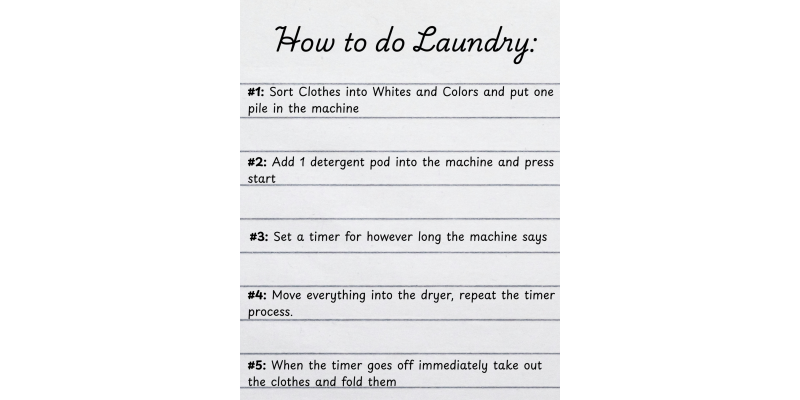
Nobody teaches you how to do laundry, stock a pantry, or know when to call a plumber versus doing something yourself. These basic daily living skills are often assumed to come naturally and for many autistic and ADHD adults, they simply do not. Breaking tasks into small steps removes the overwhelm and makes the unfamiliar feel manageable for autistic adults.
Executive dysfunction affects sequencing (knowing what order to do things in) and maintaining routines. Research specifically links executive function deficits to difficulties in adaptive daily living skills in autistic adults. A simple chore can feel overwhelming if your brain is trying to hold 12 steps in memory while also managing sensory input from the environment.
The answer is visual checklists and routines. Write out the steps of tasks that you repeat regularly: a morning routine, a laundry process, a grocery shopping list template. Once the steps are written, your brain doesn't have to re-figure them out each time. It just follows the list.
For parents, practice these skills at home before your child leaves. Don't do everything for them, do it alongside them while narrating the steps. That guided practice helps your child learn the skill over time.
🏠 Checklist Idea: Create a 'home reset' checklist that takes 15 minutes per day: dishes, clean surfaces, trash check, laundry check. Laminate it and hang it in the kitchen. The visual cue removes the need for your brain to remember it.
Practical Strategies:
- Write step-by-step checklists for repeating tasks: laundry, cooking, cleaning, grocery shopping.
- YouTube is an underrated resource, search 'how to do [task] for beginners' for clear, visual walkthroughs.
- Try the 'one load' rule: do one load of laundry start-to-finish on the same day every week so it becomes automatic.
⭐ Bonus Tip: Build Your Personal Support Team
One of the most powerful things any neurodivergent adult can do is build a small, intentional support network. This doesn't mean you need a lot of people, you need the right ones. Think about one person who can help you problem-solve (a trusted friend or family member), one community of people who 'get it' (online autism and ADHD communities can be lifesaving), and one professional who specializes in neurodivergence.
If you've tried the strategies in this post and things still aren't clicking, that's not a sign that you're broken. It's a sign that you might benefit from working with someone who specializes in exactly this.
An executive functioning coach who understands autism and ADHD can help you figure out which strategies actually fit your brain, build systems you'll realistically follow, and work through the obstacles that keep tripping you up.

Coaching is a judgment-free space to figure out what's getting in your way and build a plan to move forward.
Adulting is hard for everyone. But for neurodivergent adults navigating a world not designed for their brains can feel like trying to follow a map written in a language nobody taught you.
The good news is that these skills are learnable. They don't come naturally to most autistic and ADHD adults and that is not a failure. It just means you need different tools, different systems, and sometimes a different starting point. The eight skills in this post are that starting point.
Whether you're budgeting for the first time, finally setting up a doctor's appointment, or learning to start tasks without a full blown internal battle, every step forward counts. Progress looks different for every person. Grow Autism Coaching specializes in these real-life challenges for individuals with autism or ADHD. Book a free consultation call here to see if coaching is the right fit for your needs.
Frequently Asked Questions (FAQs)
Q1: My autistic adult child refuses help with these life skills. What should I do?
Resistance often comes from a place of overwhelm, shame, or past negative experiences with being 'taught' skills. Instead of direct instruction, try collaborative problem-solving: ask your child what specific part of a task feels hardest and work on just that piece. Autonomy matters. Let them lead the conversation about what support they want and what they don't. Working with a neurodivergent-affirming coach can also be a helpful way to introduce skills with a neutral third party, someone who isn't mom or dad.
Q2: Are there apps specifically designed for autistic and ADHD adults for these skills?
Yes, several. Tiimo is a visual daily planner built specifically with neurodivergent users in mind. Focusmate helps with task initiation through body doubling. Goblin Tools breaks tasks into smaller steps automatically using AI. Google Calendar and YNAB (You Need a Budget) are not neurodivergent-specific but are highly recommended in the community for their visual clarity and flexibility.
Q3: I'm an autistic adult and I'm embarrassed that I don't know these things. Is that normal?
Completely normal and incredibly common. Most educational systems do not teach executive functioning skills explicitly and they especially don't teach them in ways that work for neurodivergent brains. Many adults are figuring these things out in their 20s, 30s, 40s, and beyond. There is no timeline you're supposed to be on.
Q4: How do I know if I need professional support for executive functioning?
If executive functioning challenges are significantly affecting your daily life (your ability to manage your schedule, handle money, start tasks, or meet your basic needs) working with a coach who specializes in neurodivergence could make a real difference. At Grow Autism Coaching, we work specifically with autistic and ADHD adults on these exact challenges.
Q5: What if my child is transitioning out of high school right now? Where do I start?
Start with the two or three skills that will have the most immediate impact on their daily independence. For most families, that means appointment management, basic budgeting, and a daily routine. Don't try to teach everything at once. Connect with your school district's transition planning team if your child has an IEP, and look into vocational rehabilitation (VR) services in your state, which are federally funded programs that support adults with disabilities in developing employment and independence skills.
