
Executive Functioning Skills Explained and Why They Matter
Have you ever watched a bright, capable person completely fall apart when a plan changes unexpectedly? Or wondered why your child can explain a complex video game in perfect detail but cannot remember to bring their homework folder home? The answer may have nothing to do with intelligence or effort. It often comes down to executive functioning.
Executive functioning is one of the most talked about terms in autism and ADHD communities right now, and for good reason. Research suggests that a large majority of autistic people, often estimated around 70 to 80 percent, experience some degree of executive function difficulty. For people with ADHD, executive dysfunction is considered one of the most central challenges of the condition, not just a side effect.
Yet despite how common and how impactful these challenges are, many families and individuals have never received a clear explanation of what executive functioning actually is or what they can do about it.
This post changes that. Whether you are an autistic adult navigating daily life, a parent supporting a child, or someone living with ADHD looking for answers, this guide covers everything you need to know about what executive functioning is, what the 9 core executive functioning skills are, and how to build real, lasting support around them.
In this article you will learn:
- What executive functioning is
- All 9 executive functioning skills explained
- How autism and ADHD affect each skill
- Practical strategies and supports
- How an executive functioning coach can help
- IEP goal ideas for parents and educators
- A bonus tip that can make an immediate difference
1. What is Executive Functioning?
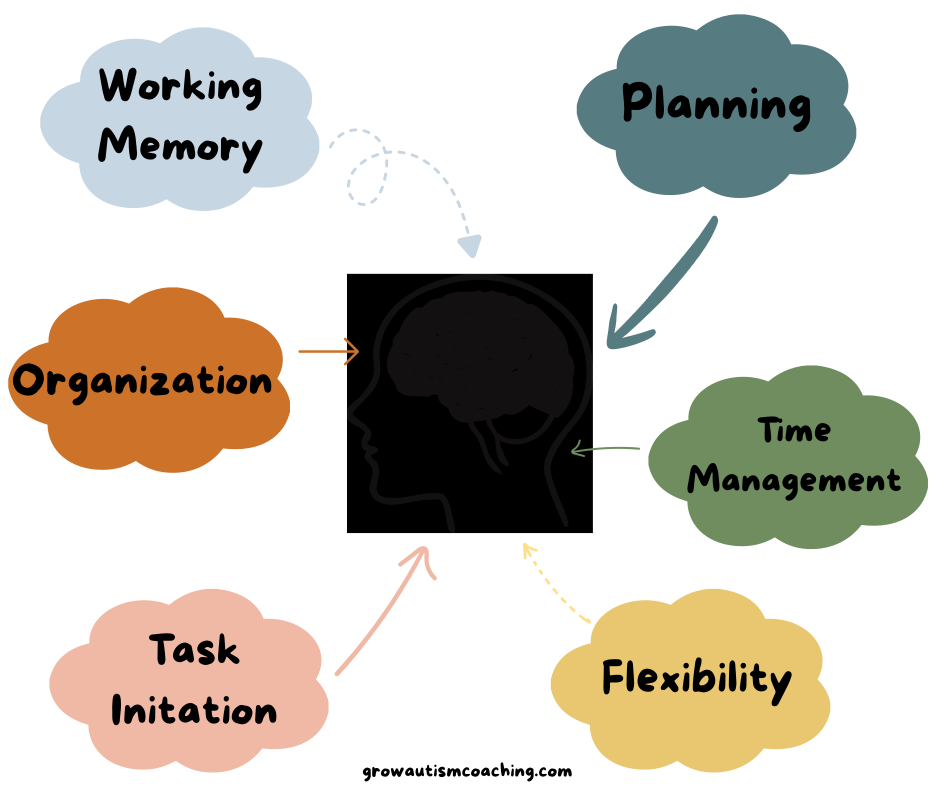
Before breaking down the individual skills, it helps to understand what executive functioning actually means. Executive functioning refers to a set of mental processes that help people plan, focus attention, remember instructions, and manage multiple tasks successfully.
Think of it as the manager of your brain. Just like a good manager does not do every job in a company but makes sure all the jobs get done in the right order by the right people, your brain's executive functioning system coordinates your thoughts, emotions, and behaviors so you can achieve goals and adapt to your environment.
In autism, these skills may develop more slowly or unevenly. That means a person can be very bright in some areas yet struggle greatly with everyday tasks like getting ready in the morning, organizing schoolwork, or managing their time. This uneven profile is one reason autistic people are sometimes misunderstood as lazy, unmotivated, or not trying, even when they are trying very hard.
When executive functioning is significantly impacted, it is sometimes referred to as executive functioning disorder, though this is not a standalone diagnosis. It is most commonly associated with autism spectrum disorder (ASD) and ADHD, and it can also occur alongside learning disabilities, anxiety, depression, and traumatic brain injury.
Why It Matters:
Across childhood, adolescence, and adulthood, executive function challenges can affect school performance, independence, employment, and relationships for autistic people. This is not a childhood only issue. Adults with autism and ADHD experience significant executive function difficulties and many have never had these challenges properly identified or supported.
2. Working Memory: Your Brain's Sticky Note

Working memory is your brain's ability to hold onto information temporarily while you use it. Think of it like a mental whiteboard: you write something on it, use it, and then erase it. It is what helps you remember a phone number long enough to dial it, follow a multi-step instruction, or track what someone just said mid-conversation.
For people with autism or ADHD, that whiteboard tends to be smaller and gets erased faster. You might forget what you were doing mid-task, lose track of a conversation, or struggle to follow directions with more than two or three steps. This is not laziness. It is a neurological difference in how the brain temporarily stores and uses information.
In real life, working memory challenges in autism can look like this: losing track of items like keys, a phone, or school materials, or skipping steps in routines like showering, packing a bag, or cooking. A person may also struggle to follow multi-step instructions at school or work, even when they fully understood each step the moment it was given.
Strategies and Supports:
- Use visual checklists and written instructions instead of relying on verbal memory alone
- Break tasks into single steps with one clear action per step
- Record voice memos or use a notes app the moment information is given
- Repeat key information out loud to strengthen short-term retention
- Post visual reminders in the physical environment (bathroom mirror, front door, desk)
Real-Life Example: A teacher gives a student three tasks. By the time the first one is completed, the student can’t remember the next tasks. Writing down instructions the moment they are spoken, rather than relying on memory, can completely change the outcome.
Executive functioning IEP goal idea: "Student will use a written checklist to independently complete a 3-step classroom routine with 80% accuracy across 4 consecutive weeks."
3. Cognitive Flexibility: The Ability to Shift Gears
Cognitive flexibility, also called mental flexibility, is your brain's ability to switch between different thoughts, tasks, or situations. It is what allows you to adapt when plans change, see a problem from a different angle, or move from one topic to another without getting stuck.
Research consistently highlights cognitive flexibility as the most commonly impaired executive functioning skill in autism. Rigid thinking and difficulty with changes in routine are directly linked to cognitive flexibility challenges. When plans change unexpectedly, it can feel genuinely distressing, not just inconvenient. The brain can get locked into one way of thinking or doing things, making transitions and unexpected changes feel overwhelming or even threatening.
A real-life example: melting down or freezing when a plan changes suddenly, like a cancelled class, a different route home, or a schedule shift at work. This is not a behavior problem. It is the brain struggling to shift gears in a situation where the expected path has disappeared.
For people with ADHD, cognitive flexibility can look different. They may hyperfocus on one task, like researching a hobby late into the night, and find it genuinely hard to stop or switch to other responsibilities. This is a flexibility and inhibition challenge working together.
Strategies and Supports:
- Give advance notice of upcoming transitions, such as "In 10 minutes, we will be switching activities"
- Use visual timers to show that change is approaching
- Introduce "Plan B" options in advance so the person is not blindsided when things shift
- Practice small, low-stakes flexibility in everyday moments, like trying a different snack or a new route on a walk
- Validate the discomfort of change while gently encouraging adaptability over time
Executive functioning IEP goal idea: "When presented with an unexpected change in routine, student will use a visual support or coping strategy to transition within 5 minutes with minimal prompting, across 3 out of 4 opportunities."
4. Inhibitory Control: The Pause Button
Inhibitory control, sometimes called response inhibition or impulse control, is your brain's ability to pause before acting. It is the mental brake that stops you from blurting out something in the moment, acting on impulse, or getting distracted when you need to focus.
For people with ADHD, difficulty with inhibitory control is one of the most recognized hallmarks of the condition. Interrupting conversations, acting impulsively, or struggling to wait your turn are all signs of a challenged inhibitory control system, not a character flaw.
In autism, inhibitory control challenges can look different. They may involve difficulty stopping a repetitive behavior even when you want to, or getting caught in a loop of thought or action that is hard to exit. Strong sensory input, like noise, lights, or textures, can also overload available executive resources and make it even harder to inhibit reactions or pause before responding.
Research Note: A 2024 meta-analysis published in the journal Children found that both ASD and ADHD groups showed significantly more difficulty with inhibitory control compared to typically developing peers, confirming that this is a neurological difference, not a willpower problem.
Strategies and Supports:
- Teach and practice the "stop, think, act" framework as a daily habit
- Use environmental cues, like a sticky note that says "Wait 5 seconds" near common trigger areas
- Practice mindfulness techniques that build awareness between feeling and reaction
- Reduce sensory overload and distractions in the environment to lower the demand on executive resources
- Identify and reduce the specific triggers that make impulse control harder
Executive functioning IEP goal idea: "Student will use a self-regulation strategy (such as counting to 5 or raising a hand) before responding in group settings, across 4 out of 5 observed opportunities."
5. Planning and Organization: Building the Roadmap

Planning is the ability to identify a goal, map out the steps needed to reach it, and organize those steps in a logical order. Organization is keeping your environment, materials, and time structured so you can act on those plans. Together, they are the roadmap and the vehicle for getting things done.
Devising a plan can be overwhelming for autistic people. They may struggle to break a big goal into manageable pieces, or become so focused on getting the details exactly right that they never move forward. With ADHD, planning often fails at the execution stage: the plan makes sense in theory, but starting or following through feels impossibly difficult.
A common real-life example: appearing disorganized, forgetful, or like they are not trying, even when they care deeply. A student who consistently loses materials, forgets assignments, or cannot sequence the steps of a project is very often not careless. Their planning and organization systems simply need external support.
Strategies and Supports:
- Teach backward planning: "The project is due Friday. What needs to happen Thursday, Wednesday, and so on?"
- Give specific written or visual instructions, not just verbal ones
- Use project management apps like Todoist, Notion, or a simple paper planner to break goals into daily tasks
- Color-code schedules, folders, and materials by subject or category
- Work with a coach, parent, or support person to build weekly plans collaboratively
Executive functioning IEP goal idea: "Student will use a written planner to record assignments and break multi-step projects into daily action steps with adult support fading to independence over 8 weeks."
6. Task Initiation: Getting Started is the Hardest Part
Task initiation is the ability to begin a task independently, without excessive prompting or avoidance. It sounds simple. But for many autistic people and those with ADHD, starting something, even something you genuinely want to do, can feel like trying to push through an invisible wall.
This is sometimes called "activation energy." In ADHD, dopamine dysregulation makes it especially difficult to generate this starting energy without external pressure, urgency, or strong personal interest. In autism, difficulty getting started may also be linked to cognitive rigidity, anxiety about getting things right, or a need to mentally rehearse the full task before beginning.
A common real-life example: struggling to start homework or chores without lots of prompting, even when the person knows exactly how to do them. This is task initiation. It is not defiance. It is not a lack of caring. It is a specific, neurologically-based barrier.
Parent and Caregiver Tip: If your child or loved one seems to "freeze" before tasks, resist the urge to interpret this as defiance. Try gently starting the task alongside them. Sometimes a warm, calm presence is all it takes to get the engine running. This is called body-doubling, and it is one of the most effective and underused strategies available.
Strategies and Supports:
- Use a "2-minute rule": if something takes less than 2 minutes, do it now
- Set a timer for just 5 minutes and commit only to starting, not finishing
- Create external accountability with a friend, coach, or body-doubling partner
- Make the starting environment as easy as possible by laying out materials in advance
- Use predictable routines so that starting feels more automatic
Executive functioning IEP goal idea: "Given a visual schedule and a prepared workspace, student will independently initiate an assigned task within 3 minutes of instruction, across 4 out of 5 trials."
7. Emotional Regulation: Managing the Storm Inside
Emotional regulation is the ability to manage and respond to your emotional experiences in a flexible, adaptive way. It includes recognizing what you are feeling, understanding why, and choosing how to respond rather than simply reacting in the moment.
For autistic people and those with ADHD, emotional regulation is one of the most impactful executive functioning challenges. Emotional outbursts or shutdowns when demands or changes pile up are directly connected to this skill, as well as to flexibility and the overall overload of executive resources. When the brain is already working hard to manage sensory input, transitions, and unexpected information, there is simply less capacity left to regulate emotional responses.
A study from the Neuroscience & Biobehavioral Reviews found that executive function and emotional regulation are closely linked in both autism and ADHD, meaning that when executive functioning skills are weaker, emotional dysregulation tends to be more intense. This is not being dramatic, it's neuroscience.
Strategies and Supports:
- Build a personal "emotional toolkit" with breathing techniques, movement breaks, fidgets, or sensory tools that help the individual return to calm
- Use visual emotion scales, like the Zones of Regulation, to build emotional vocabulary before a crisis occurs
- Practice identifying early warning signs of overwhelm before emotions escalate
- Reduce sensory overload and unnecessary cognitive demands to protect emotional regulation capacity
- Work with a therapist or executive functioning coach trained in neurodivergent emotional regulation
Executive functioning IEP goal idea: "When experiencing frustration or anxiety, student will independently use a coping strategy from their personal toolkit to return to a regulated state within 10 minutes, across 3 out of 4 observed situations."
8. Time Management: The Invisible Enemy

Time management is the ability to understand how much time is available, estimate how long tasks take, prioritize what needs to be done, and pace yourself accordingly. It is one of the highest-level executive functioning skills because it depends on several other skills working together: planning, working memory, and sustained attention.
Many people with ADHD describe living with "time blindness," a term used to describe the difficulty of sensing time passing. The world can feel like it exists in only two time frames: now and not now. This makes deadlines, schedules, and appointments genuinely difficult to track and respect, not because the person does not care, but because the brain's internal clock works differently.
Autistic people may also struggle with time management, particularly with estimating how long tasks will take, managing multiple time commitments at once, or shifting from one activity to another when time is up. These challenges can directly affect school performance, employment, and independence across the lifespan.
Strategies and Supports:
- Use visible, analog or digital timers, especially visual timer apps like Time Timer, that show time passing as a physical shape
- Always over-estimate time: "If I think it will take 20 minutes, budget 40"
- Set multiple reminder alarms, not just one, leading up to important events or transitions
- Keep a consistent weekly schedule so the structure becomes automatic and requires less active management
- Use external structure: calendars, alarms, and visual schedules to reduce how much the brain has to track internally
Executive functioning IEP goal idea: "Student will use a visual timer to independently monitor and transition between scheduled activities with no more than one adult prompt, across 4 consecutive school days."
9. Metacognition: Thinking About How You Think

Metacognition is your ability to think about your own thinking. It involves self-monitoring (noticing how you are doing while you are doing it), self-evaluation (reflecting on what worked and what did not), and self-correction (adjusting your approach based on what you have learned). It is the skill that lets you step back and observe yourself from the outside.
Metacognition is what helps you realize mid-task that you have gone off track, or look back on a situation and understand what you could do differently next time. For many autistic and ADHD individuals, this reflective awareness is harder to access, especially in the moment. Research published in the Journal of Autism and Developmental Disorders notes that adults with autism show particularly significant challenges in the metacognition domain, and that these challenges are among the strongest predictors of depression symptoms and reduced daily functioning.
This is also the executive functioning skill most directly targeted by executive functioning coaching. A skilled EF coach helps individuals develop awareness of their own patterns, build strategies that fit their specific brain, and reflect on what is working over time. Grow Autism Coaching specializes in executive functioning skills and helps individuals (whether neurodivergent or not) build systems to support real change.
Strategies and Supports:
- Use daily journaling prompts: "What went well today? What was hard? What would I do differently?"
- Work with an executive functioning coach who can help identify patterns across time and situations
- After completing tasks, do a brief "debrief" to review what helped and what did not
- Teach and model positive self-talk: "Let me pause and check. Is what I am doing working?"
- Use goal-tracking tools to make progress visible, which supports self-evaluation
Executive functioning IEP goal idea: "After completing an assignment, student will independently complete a 3-question self-reflection checklist (What did I do well? What was hard? What will I try next time?) with 80% accuracy across 4 weeks."
Bonus Tip: Build Your External Brain 🧠
One of the most powerful things any autistic person or anyone with ADHD can do is stop relying solely on their internal brain to manage life and start building an "external brain" instead. This means offloading as many mental tasks as possible onto tools, systems, and routines: physical planners, calendar apps, voice reminders, checklists on the wall, whiteboards, and habit trackers.
Your brain is brilliant at many things. Let external tools handle the parts it finds hard. This is not a crutch. It is a strategy. Many highly successful neurodivergent adults swear by it. The goal is not to fix your brain. It is to set up a world around you that works with your brain, not against it.
An executive functioning coach can help you build a personalized external brain system that fits your specific life, goals, and neurotype. If you would like a FREE coaching consultation click here.
Moving Forward:
Executive functioning skills are not luxuries. They are the invisible architecture behind nearly everything we do. For autistic people of all ages, parents supporting children with autism, and adults with ADHD or ADD, understanding these 8 skills can be genuinely life-changing. Not because the challenges disappear, but because they finally have a name.
When we understand that working memory, cognitive flexibility, inhibitory control, planning, task initiation, emotional regulation, time management, and metacognition are all areas where neurodivergent brains work differently, we stop blaming the person and start building better supports.
The research is clear: because executive functioning is so strongly linked to daily living skills and quality of life, targeted supports and accommodations make a real, measurable difference. Predictable routines, direct skill teaching, sensory supports, and personalized executive functioning coaching are not extras - they are essentials. The goal is not perfection. The goal is progress, one strategy at a time.
Frequently Asked Questions About Executive Functioning (FAQs)
Q: What is executive functioning, in simple terms?
Executive functioning refers to the set of mental skills your brain uses to plan, focus, start tasks, manage emotions, and adapt when things change. Think of it as your brain's internal manager. The term "executive functioning disorder" is used when these challenges are significant and persistent, as commonly seen in autism and ADHD.
Q: What are executive functioning skills for kids, and how are they different from adults?
The core executive functioning skills are the same across all ages, but they naturally develop over time and are not fully mature until the mid-20s. In autistic children, these skills may develop more slowly or unevenly, meaning a child can seem advanced in some areas while needing significant support in others. External structure, visual tools, and consistent routines are the most effective supports for executive functioning skills for kids.
Q: What does an executive functioning coach do?
An executive functioning coach helps individuals identify their specific EF challenges and build personalized systems for daily functioning. Executive functioning coaching focuses on practical skills like time management, organization, task initiation, and planning. It is not therapy, but it works very well alongside it. Click here for a free consultation call at Grow Autism Coaching.
Q: What are executive functioning IEP goals, and how do I get them added?
Executive functioning IEP goals are measurable goals written into a student's Individualized Education Plan that target specific EF skills like task initiation, organization, or flexible thinking. To get them added, request a meeting with your child's IEP team and ask for EF skills to be assessed and addressed. Occupational therapists and school psychologists are often the key people to involve in this process.
Q: Can executive functioning skills actually improve?
Yes. While executive functioning challenges in autism and ADHD are neurological, they are not fixed or permanent. With targeted strategies, executive functioning coaching, and consistent supports, people of all ages can make meaningful improvements over time.
