
Where to Start After a Late Female Autism Diagnosis
You’ve just received your autism diagnosis and it might not feel the way you expected. For some, there’s relief. For others, confusion, grief, or even overwhelm. For many, it’s all of those at once.
How did it take this long?
Why did no one see it?
And now what?
If that's where you are right now, you are not alone.
In 2024, nearly 1 in 4 women newly diagnosed with autism were diagnosed as adults (age 19+), that’s more than double the rate seen in men (EPIC Research). And while awareness is finally growing, the road after a late female autism diagnosis can still feel overwhelming because there's no official roadmap handed to you along with the paperwork.
This article is that roadmap. Whether you were diagnosed last week or last year, whether you're flooded with relief or buried in grief (or both at once), these 8 steps will help you understand what's happening, where to focus, and how to truly start living as your full, authentic self.
What You'll Learn in This Article
- Why many women are diagnosed late
- How to process the emotions after diagnosis
- How to start unmasking safely
- How to rebuild your identity
- Community, accommodations, and advocacy
- How autism coaching can help
- Tools to guide your next steps
1. Understand Why Females are Diagnosed with Autism Late:

The first thing you need to hear is the delay wasn't because your autism was hidden. It was hidden because the system wasn't built to find you.
A 2025 review published in Autism Research found that later autism diagnoses are significantly more common among women, racial and ethnic minorities, and those living in rural communities. The diagnostic criteria have historically been normed on male-presenting autism, meaning that autistic women and girls often display more nuanced behavioral profiles that go undetected. The Journal of Child Psychology and Psychiatry confirms that autistic females are frequently underdiagnosed, misdiagnosed, and diagnosed later than their male peers, even when autistic traits are equally present.
One major reason is something called the "female autism phenotype,” a pattern of autistic traits that tends to look different from the textbook descriptions professionals were trained to recognize. Women are more likely to have strong verbal skills, be socially motivated, and show their autism through internalized distress rather than obvious behavioral differences.
Add to that the powerful force of masking (consciously or unconsciously hiding autistic traits to fit in) and it becomes clear why so many women fly under the radar for decades.
Understanding this context isn't about blame, it's about releasing the self-doubt you may have carried for years. You weren't "too subtle." You weren't "not autistic enough." The lens being used simply wasn't designed for you.
📌 Practical Tip: Write down 3-5 moments from your past that now make sense through an autism lens. This isn't about regret — it's about recontextualizing your story with compassion.
2. Processing Your Emotions After a Late Autism Diagnosis

After a late autism diagnosis, the emotional response rarely fits neatly into one box. You might feel relief and grief in the same hour. You might feel excitement on Monday and rage on Thursday. All of it is valid.
Research from a 2025 study of autistic women diagnosed after age 30 identified seven emotional themes in their diagnostic journeys, including: frustration at barriers, fear and self-doubt, grief over the past, shock of a new self, anger at being dismissed, the relief of authenticity, and pride in community.
This emotional arc is normal. A diagnosis doesn't erase the past. It reinterprets it and that reinterpretation takes time. Be patient with yourself as you process. There's no deadline on grief, and there's no "right" way to feel about finally having a name for your experience.
Research on autistic identity after diagnosis found that the time elapsed since diagnosis matters: more time since the diagnosis was linked to less dissatisfaction with autistic identity and higher self-esteem. In other words, it gets better. But first, let yourself feel it.
📌 Practical Tip: Try journaling your emotional responses day by day in the weeks after your late autism diagnosis. Seeing your feelings on paper can help you process them without judgment — and you may find patterns that reveal important things about your needs.
3. Start Learning About Autism in Females
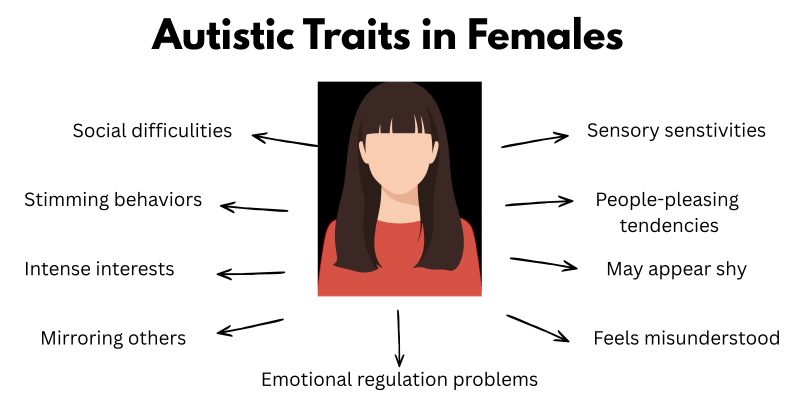
One of the most powerful things you can do after receiving a late autism diagnosis is to actually learn about autism - specifically, what autism looks like in women and girls. Chances are very little of what you've read or heard about autism actually describes you.
The female autism phenotype often includes strong verbal and social mimicking skills, intense focus on people-pleasing, deeply internalized anxiety rather than outward meltdowns, rich imaginative inner worlds, and special interests that may look more socially acceptable (writing, reading, psychology, animals, music). Many women with autism are misdiagnosed with anxiety, depression, borderline personality disorder, or eating disorders for years before autism is considered.
The numbers are staggering: one study found that 62.7% of autistic females had at least one prior psychiatric diagnosis, compared to 37% of males, with mood and anxiety disorders being the most common.
Learning about the female autism phenotype helps you reframe your history. Those previous diagnoses weren't wrong, but they were incomplete. They were treating symptoms without understanding the root and now you can finally understand the root.
📌 Practical Tip: Search "female autism phenotype" and "autistic women experiences”, then compare what you find to your own history. You may find yourself saying "yes" to things you never expected.
4. Begin the Process of Unmasking
Masking is the practice of suppressing, hiding, or camouflaging autistic traits to appear neurotypical. If you received a late autism diagnosis, there's a very good chance you've been masking for most of your life, possibly without even knowing it.
Masking might have looked like forcing eye contact even when it felt uncomfortable, rehearsing conversations before having them, suppressing the urge to stim (rock, tap, hum), pretending to enjoy social events that left you drained, or copying the social scripts of people around you to “fit in”.
Masking comes at a real cost. Sustained masking is linked to higher rates of anxiety, depression, and autistic burnout - a state of chronic exhaustion that can take months or years to recover from. Unmasking is not about stripping yourself down all at once or "performing" authenticity. It's a gradual, nonlinear process of allowing your genuine self to exist, first in safe spaces and then more broadly over time.
Start small. Give yourself permission to stim at home. Stop forcing eye contact in one-on-one conversations with trusted people. Say "I need a break" without apologizing for it. Notice what feels natural versus what feels like a performance.
📌 Practical Tip: Make a "masking inventory", a private list of things you do to appear neurotypical. Then circle the ones that cost you the most energy. Start there. Which one could you experiment with dropping in a safe space first?
5. Rebuild Your Identity After Your Late Autism Diagnosis
Researchers describe a process of "retrospective re-evaluation" after diagnosis, where adults revisit and reinterpret past experiences through an autism lens. This often brings relief and grief at the same time, along with a period where things feel unclear as identity is being rebuilt.
You may find yourself questioning past relationships, career choices, and coping strategies - not out of regret, but to understand them through a new lens. This is healthy and necessary. You're not dismantling your life, you're seeing it more clearly for the first time.
Identity rebuilding after a late autism diagnosis might look like:
- Embracing the label “autistic” (if it feels right for you)
- Rediscovering your true interests beyond people-pleasing
- Setting boundaries that honor your energy and sensory needs
- Understanding how autism shapes your strengths
Give it time, identity doesn’t change overnight. But it does shift and over time it usually starts to feel more real and more like you.
📌 Practical Tip: Try asking yourself: “If I didn’t worry about what anyone else expects from me, what do I actually enjoy?” Write about it regularly, you might be surprised by what comes up.
6. Find Your Community

One of the most consistent findings in research on late autism diagnosis is the power of belonging. Many women describe spending decades feeling like they were "too much" or "not enough".
A late autism diagnosis changes that. Research consistently finds that receiving a formal diagnosis increases a sense of belonging and enables a more positive sense of self. particularly when it connects individuals to an autistic community.
Community doesn't have to mean in-person groups (though those can be wonderful). It might mean online forums, Reddit communities, Instagram accounts run by late-diagnosed autistic women, or local neurodiversity meet-ups.
Hearing other women say “me too” about things you thought were just you (textures, social stuff, hyper-fixating on interests) can really shift things. It makes you realize you’re not the only one and there’s a whole community you just hadn’t found yet.
Useful resources: Autistic Women & Nonbinary Network (AWN) is a wonderful starting point for community and advocacy.
📌 Practical Tip: Spend one hour this week exploring online autistic women's spaces, without the goal of "learning" anything. Just listen and see how it feels to be among people who get it.
7. Learn to Advocate for Yourself and Access Accommodations
A late autism diagnosis is more than an explanation, it's a key. It opens doors to accommodations, supports, and rights you may not have known you were entitled to.
In the workplace, autistic adults can request reasonable accommodations under the Americans with Disabilities Act (ADA). These might include flexible work hours, the option to work remotely, noise-canceling headphones, written rather than verbal instructions, or a quieter workspace. Research shows that when accommodations are in place, autistic adults demonstrate high productivity and job satisfaction.
In educational settings, similar accommodations exist; extended time, quiet testing environments, and written communication options. These can make a significant difference for autistic adults returning to school.
Self-advocacy doesn't mean loudly demanding things. It means knowing what you need, knowing you have the right to ask for it, and being able to communicate that - even when it feels uncomfortable. This is a skill that grows with practice.
Start with: JAN (Job Accommodation Network) — a free resource offering guidance on workplace accommodations for autistic adults.
📌 Practical Tip: Write a "needs list". What specific adjustments to your work or home environment would reduce your daily stress by 20%? Start small and start advocating for just one item on that list.
8. Get the Right Support: Autism-Affirming Coaching and Therapy

Not every therapist is the right fit, especially when it comes to understanding autism in women. After a late autism diagnosis, it helps to look for support from professionals who take an autism-affirming approach.
Autism-affirming support does not try to make you appear less autistic. It does not focus on "fixing" traits. Instead, it helps you understand your nervous system, set boundaries that work for you, recover from burnout, reduce masking in safe contexts, and build a life that aligns with your genuine needs and strengths.
This is exactly where Grow Autism Coaching comes in. We specialize in supporting autistic adults, including women navigating a late autism diagnosis. Our coaching approach is affirming, practical, and deeply personalized.
Coaching and therapy can help you process what your diagnosis means, start unmasking safely, rebuild your identity with clarity and compassion, set boundaries that protect your energy, and take concrete steps toward the life you actually want .
📌 Practical Tip: When searching for a therapist or coach, ask directly: "What is your experience supporting late-diagnosed autistic women?" and "Do you take a neurodiversity-affirming approach?"
⭐ Bonus Tip: Let Yourself Rest Without Guilt
After decades of masking, pushing through sensory overload, and trying to fit a mold that was never yours, your nervous system is likely exhausted. Autistic burnout (a state of deep mental, physical, and emotional depletion) is extremely common in late-diagnosed women.
Rest is not laziness, it’s medicine. Protecting your energy is not selfishness. One of the most powerful things you can do after your late autism diagnosis is to give yourself deliberate, guilt-free recovery time. This might mean fewer commitments, more solo time, more sensory comfort, and taking things at a slower pace.
Conclusion: You Are Right on Time
Getting a late autism diagnosis as a woman can be a really intense, complicated experience. A lot of people describe it like things suddenly click into place, but also like everything gets shaken up at the same time.
What tends to come up again and again, both in research and in women’s lived experiences, is that this isn’t an ending point. It’s more like a starting point. It’s a way to finally understand yourself better, start building a life that actually fits, and connect with people who just get it.
Whether you’re still trying to make sense of your diagnosis or you’ve been sitting with it for a while, the supports in this article are here to give you a starting framework.
Frequently Asked Questions About Late Female Autism Diagnosis
Q: Why do so many women receive a late autism diagnosis?
Autism was historically studied almost entirely in boys, leading to diagnostic criteria built around male presentations. Women tend to mask more effectively which makes autism harder to spot in traditional clinical settings.
Q: Is a late autism diagnosis still useful? I'm already an adult.
It depends. For many adults, a late autism diagnosis can be really helpful because it provides a framework for understanding lifelong patterns and it can open access to accommodations. For others, the value is less about the formal label and more about the insight and self-understanding it brings.
Q: What is autistic masking and how do I know if I've been doing it?
Autistic masking is the conscious or unconscious practice of suppressing or camouflaging autistic traits to fit in. Signs you may have been masking include: exhaustion after social events, copying others' expressions and speech patterns, and feeling like you "perform" rather than simply exist in social situations. Most late-diagnosed women have been masking for decades.
Q: What kind of support helps most after a late autism diagnosis?
Neurodiversity-affirming support is key. Look for professionals who understand autism in women specifically. Being part of a supportive community can also make a big difference, connecting with other autistic adults can help you feel less alone.
Q: How long does it take to adjust to a late autism diagnosis?
There's no fixed timeline and that's okay. Research suggests that the longer someone has had their diagnosis, the more comfortable and positive their relationship with their autistic identity tends to become. Some people feel immediate relief; others take months or years to fully integrate the diagnosis into their sense of self. Both are completely normal. What matters most is that you give yourself the time, support, and compassion you deserve.
Ready to take your next step? Book a free consultation here.
