
What is in an IEP? A Parent’s Guide to IEPs and Special Education
Did you know that 15% of public school students in the United States receive special education services under IDEA? If your child is one of them, or you're just starting to navigate the special education process, you've probably already heard the term "IEP" come up. But what does it actually mean? What's inside it? And what role do you play?
In this guide, you'll learn exactly what an IEP is, who creates it, what it includes, and how to show up as a confident, informed member of your child's team. Let’s break it all down.
Here's what we'll cover:
- What is an IEP?
- Who creates the IEP?
- What does an IEP include?
- Parent rights in the IEP process
- A bonus tip on getting extra support
What Is an IEP?
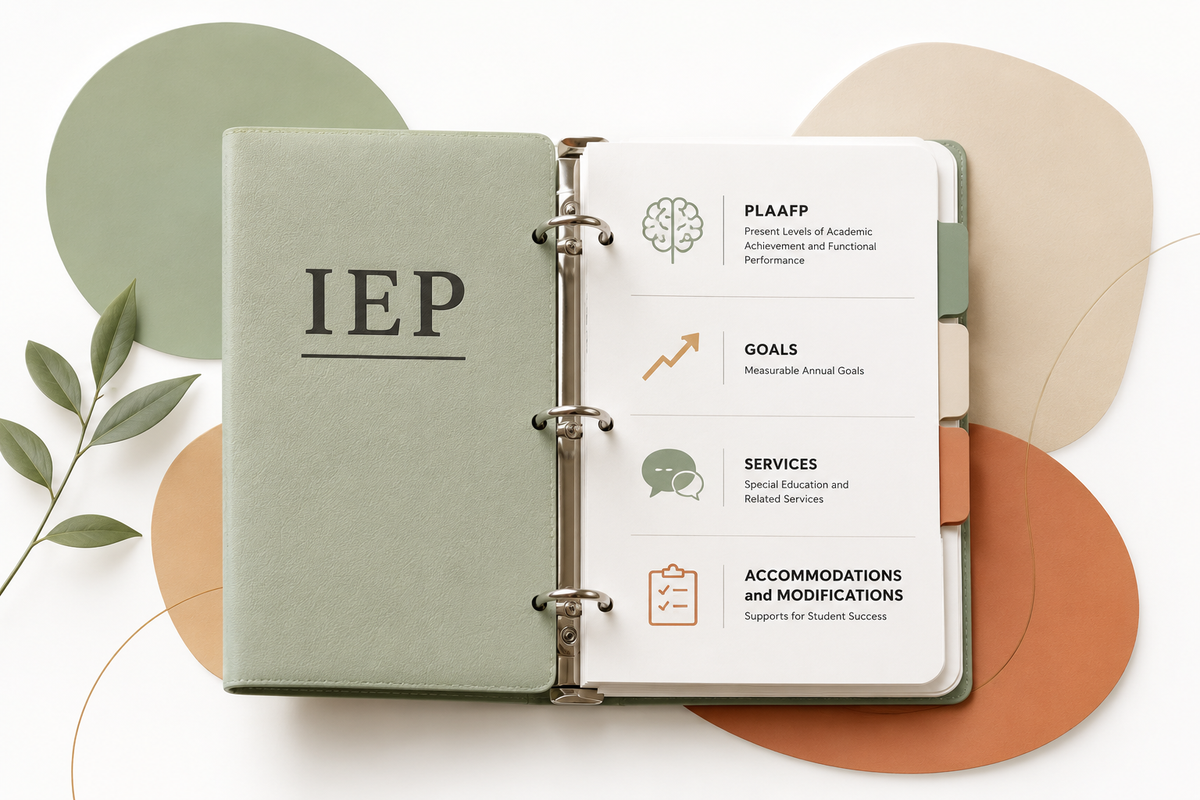
An IEP, or Individualized Education Program, is a legally binding document developed for students with disabilities who qualify for special education services. For children with autism, it serves as a personalized roadmap that outlines their unique educational needs, the goals the team will work toward, and the services and supports the school will provide.
The IEP is created under the Individuals with Disabilities Education Act (IDEA), a federal law that guarantees children with disabilities the right to a Free Appropriate Public Education (FAPE). That means the services and supports outlined in the IEP are provided at no cost to your family.
Think of the IEP like a customized game plan, one that is built specifically for your child's strengths, challenges, and learning style. It's not a one-size-fits-all document, every single IEP looks different because every child is different.
An IEP outlines the educational goals, services, and accommodations a child needs to succeed in school. It is reviewed and updated at least once a year to make sure it continues to meet the child's evolving needs.
One important thing to know: having an autism diagnosis doesn't automatically guarantee an IEP. The school must determine that autism affects your child's educational performance and that they need specialized instruction. If your child has a diagnosis, requesting a school evaluation is the first step.
Who Creates the IEP?
The IEP is developed by a group of people called the IEP team.
The IEP team must include:
- The parents or guardians of the child
- At least one special education teacher
- At least one general education teacher (if the child participates in general education)
- A school administrative representative
- Any related service providers, such as a speech-language pathologist, occupational therapist, or physical therapist
- School psychologist for evaluation results
Each team member brings a different lens to the table. Teachers share what they observe in the classroom. Related service providers have insight on communication and motor skills. And you, as the parent, bring the most important perspective of all, you know your child better than anyone in that room.
The IEP team meets at least once a year to review progress, create new goals, and update the plan. You can also request a meeting at any time if you feel something needs to be revisited.
What Does an IEP Include?
Now for the part that most parents want to know: what's actually inside an IEP? At first glance, an IEP document can look long and complex. But each section has a specific purpose, and once you know what to look for, it becomes much easier to navigate.
Under IDEA law, every IEP must include the following legally required components:
- Present levels of performance
- Measurable annual goals
- How progress toward goals will be measured and reported
- Special education services and related services to be provided
- Accommodations and supports
- The extent to which the child will participate in general education
- Placement information
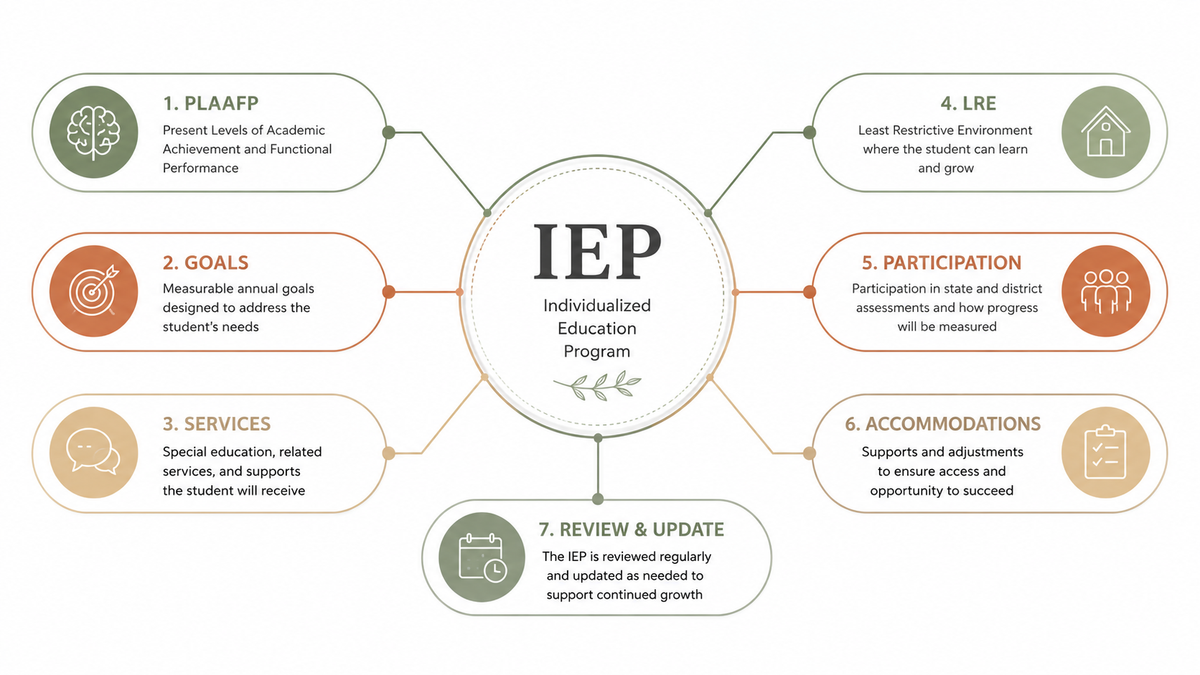
The sections are broken down below so you can fully understand each one.
Present Levels of Performance
The Present Levels of Performance, sometimes called PLOP or PLAAFP (Present Levels of Academic Achievement and Functional Performance), is the foundation of the entire IEP. Everything else in the document is built on this section.
This section describes where your child is right now - academically, socially, communicatively, and functionally.
It answers questions like:
How is your child performing in reading and math?
How do they communicate?
How do they interact with peers?
What are their strengths?
What areas need additional support?
Present levels should includes specific data, not vague descriptions. You should see things like assessment scores, teacher observations, and measurable information, not just general statements like "does well in class."
Why does this matter to you as a parent? The present levels section is your opportunity to make sure the full picture of your child is captured, including everything you observe at home that the school team may not see. You have the right to contribute information to this section and your perspective is a valuable part of building an accurate and complete plan. Share your insights because they will help the team create goals and services that truly fit your child.
Annual Goals
Once the present levels establish where your child is, the annual goals describe where the team wants them to be by the end of the year.
Good IEP goals should be SMART: Specific, Measurable, Achievable, Relevant, and Time-bound.
An example of a SMART IEP goal would be: Sarah will identify numbers 1-10 by saying the number out loud when presented with a number flashcard with 100% in 4 out of 5 trials as measured by teacher data logs.
A vague goal like "improve communication" is hard to measure.
For children with autism, goals often cover areas such as communication, social skills, academic performance, behavior, self-regulation, and daily living skills. The specific goals in your child's IEP should be directly tied to their present levels.
Ask your IEP team to walk through each goal with you. Make sure you understand what's being worked on, how it will be measured, and how often progress will be reported back to you. You deserve to know how your child is doing throughout the year, not just at the annual review.
Accommodations
Accommodations are one of the most commonly searched topics when it comes to IEPs, and for good reason. They can make a significant difference in your child's day-to-day school experience.
Accommodations are changes to how your child accesses learning, not changes to what they are expected to learn. They level the playing field so your child can fully participate in school. Accommodations do not excuse your child from completing work, they allow them to fully participate and learn.
Common IEP accommodations for students include:
- Extended time on tests and assignments
- Preferential seating to minimize distractions
- Breaks or movement opportunities during the day
- Use of noise-canceling headphones for sensory sensitivities
- Visual schedules or supports to provide structure and predictability
- Alternate testing locations away from distracting environments
- Simplified language or chunked instructions
One parent I worked with had a daughter on an IEP and was completely unsure of what her daughter's plan even included. As we worked together, she started to understand what each section meant and she realized her daughter needed an accommodation that wasn't yet in place. With that understanding, she was able to bring it up with the school team, and the accommodation was added. It was such a meaningful moment. When parents understand the IEP they become powerful advocates.
Remember: accommodations can be added or adjusted at any time by requesting an IEP meeting. You don't have to wait for the annual review.
Related Services
Related services are the specialized support services that help your child benefit from their special education program. They are provided in addition to the instruction your child receives in the classroom.
Here's a quick breakdown of what each one typically addresses:
- Speech-language therapy: communication skills, language comprehension, and social communication
- Occupational therapy (OT): fine motor skills, sensory processing, and daily living skills
- Physical therapy (PT): gross motor skills, coordination, and physical development
- Counseling or social work services: emotional well-being, social development, and behavioral support
- Assistive technology: tools and devices that help your child access the curriculum and communicate more effectively
The specific related services in your child's IEP will depend on the results of their evaluation and what the IEP team determines is necessary. Each service listed should also include the frequency and duration, meaning how often your child will receive it and for how long each session will be.
If you feel your child may need a service that isn't currently on their IEP, you have every right to bring it up at your next IEP meeting or request a meeting specifically to discuss it.
IEP Minutes
IEP minutes refer to the specific amount of time your child will spend receiving each service listed in their IEP. Every service, whether it's specialized instruction, speech therapy, occupational therapy, or any other support, must have a clearly stated frequency and duration. For example, you might see something like "speech-language therapy: 30 minutes, 2 times per week."
Why does this matter? Because these minutes are not suggestions, they are legally binding commitments. The school is required to provide the exact services documented in the IEP.
The minutes page also includes time in general education, meaning how much of the school day your child spends learning alongside their non-disabled peers. This ties directly back to the Least Restrictive Environment (LRE) requirement, the IEP must document the percentage of time your child participates in general education, as well as any time spent outside of the general education setting and the reason for it.
The minutes page should look something like this:
- The type of service being provided - speech, OT, specialized instruction, etc.
- The frequency - how many times per week or month
- The duration - how long each session lasts
- The setting - where the service will take place (general education classroom, resource room, therapy room, etc.)
- The percentage of time in general education vs. outside of general education
Placement and Least Restrictive Environment (LRE)
Under IDEA, schools are required to educate children with disabilities in the Least Restrictive Environment (LRE). This means your child should be educated alongside their non-disabled peers as much as is appropriate for their individual needs.
Placement options exist on a spectrum. Some children spend all of their day in a general education classroom with supports and accommodations. Others may spend part of their day in a resource room or specialized setting for certain subjects. Some children may be in a self-contained special education classroom for most of the day. There is no single right answer, it depends entirely on your child's needs.
If you have questions or concerns about your child's placement, you absolutely have the right to discuss this with the team. Placement is one of the most important decisions in the IEP and your voice matters.
Parent Rights in the IEP Process

One of the most empowering things you can understand as a parent is that you are not just a passive observer in the IEP process. You are an equal member of the team with legal rights that protect your involvement every step of the way.
IDEA makes it clear that parents are vital members of the IEP team, and open communication between families and schools leads to the best outcomes for children.
Here are some of the key rights you have as a parent in the IEP process:
- The right to participate in all IEP meetings and contribute to decisions about your child's education
- The right to receive prior written notice before the school proposes or refuses any change to your child's IEP
- The right to give or deny consent for evaluations and services
- The right to request an IEP meeting at any time — you don't have to wait for the annual review
- The right to request an Independent Educational Evaluation (IEE) if you disagree with the school's evaluation
- The right to bring others with you to IEP meetings, including advocates or professionals who know your child
- The right to review and request copies of all of your child's educational records
Read a more in depth post explaining procedural safeguards here.
🌟 Bonus Tip: You Don't Have to Figure This Out Alone
Grow Autism Coaching offers one-on-one coaching for parents of children with disabilities, helping you understand your child's IEP, prepare for meetings, and advocate confidently for the support your child needs.
Not sure where to start? Book a free consultation call today.

Moving Forward
The IEP process can feel overwhelming at first, but now you have the foundation you need to walk into any IEP meeting with clarity and confidence. From understanding what an IEP is and who creates it, to knowing what each section means and what rights you hold as a parent, you are no longer starting from zero.
Your child's IEP is not just a document - it's a plan built specifically for them, with your input as an essential part of the process. The more you understand it, the more effectively you can partner with your child's school team to make sure it truly reflects your child's needs and potential.
Review the IEP. Ask questions. Show up to every meeting knowing that your voice carries real weight. Your child is lucky to have someone who cares enough to learn all of this, and that effort makes a real difference in their educational and life journey.
Frequently Asked Questions (FAQs)
Q: What is an IEP for autism?
An IEP (Individualized Education Program) is a legally binding document developed under IDEA for students with disabilities, including autism, who qualify for special education services. It outlines your child's current performance levels, annual goals, the services they will receive, and the accommodations that must be in place, all tailored specifically to their individual needs.
Q: Does my child automatically get an IEP if they have an autism diagnosis?
Not automatically. The school must determine that autism is adversely affecting your child's educational performance and that they need specialized instruction. Many children with autism do qualify, but a formal evaluation is required first.
Q: What is the difference between accommodations and modifications in an IEP?
Accommodations change how your child accesses learning; for example, extended time or preferential seating, without changing what they are expected to learn. Modifications change the actual content or expectations; for example, a reduced number of problems on an assignment. Both can be included in an IEP depending on your child's needs.
Q: How often is the IEP reviewed?
The IEP must be reviewed and updated at least once a year. However, you can request an IEP meeting at any time if you feel your child's needs have changed or something in the plan isn't working. The school is required to respond to your request.
Q: Can I add something to my child's IEP after it's been created?
Yes! You have the right to request an IEP meeting at any time to discuss changes, add accommodations, or address concerns. You don't have to wait for the annual review. Simply put your request in writing and send it to your child's special education teacher or case manager.
