
A Parent’s Guide to IEPs, 504s, IDEA, and FAPE
A Plain-Language Guide to Your Child's Special Education Rights
Your child just received an autism diagnosis or your child is getting ready to enter the school system and suddenly you’re hearing words like IDEA, FAPE, IEP, and 504 Plan. It can be confusing and feel like you suddenly need to learn a brand-new language.
Know that you are not alone. According to the NCES, 7.5 million students (ages 3–21) received special education services in 2023. Each year more and more parents are finding themselves sitting in school meetings not fully understanding their rights or their child's options.
As a special education teacher, I saw this time and time again. We’d have meetings where parents didn’t seem like they fully understood what was happening, but were too overwhelmed or unsure what to ask in the moment. This is why I created this guide, to help you understand exactly what IDEA, FAPE, IEP, and 504 mean and how to use that knowledge to fight for the education your child deserves.

📊 Did You Know?: Autism now accounts for nearly 15% of all school-age students with disabilities under IDEA, which is up from just 5% in 2009. The number of students with autism in special education has more than doubled in recent years.
Here's What We'll Cover:
- What IDEA Is and Why It Matters
- What FAPE Means for Your Child’s Rights
- IEP Explained
- 504 Plan Explained
- IEP vs. 504 Plan
- What If You Disagree With the School?
- Support & Accommodations After High School
1. What Is IDEA?
IDEA stands for the Individuals with Disabilities Education Act. It is a federal law, first passed in 1975, that guarantees children with disabilities the right to a free and appropriate public education. Without IDEA, many children, including autistic children, could legally be turned away from public schools.
IDEA is the blueprint that everything else is built on, including FAPE, IEPs, and 504 Plans.
What Does IDEA Actually Do?
- It requires public schools to identify children who may need special education services, even before parents ask
- It covers 13 specific disability categories (read what they are here!)
- It guarantees that evaluations are free to families
- It gives parents specific legal rights at every step of the process, called procedural safeguards
- It requires schools to educate children in the Least Restrictive Environment (LRE), meaning alongside non-disabled peers as much as possible
Why Does IDEA Matter for Autistic Parents?
Because autism is one of the 13 categories covered under IDEA, your child has a path to services but they still need to qualify through an evaluation. IDEA also gives you the right to request a formal evaluation in writing if you believe your child needs special education services. The school must respond within a set timeframe.
Pro Tip: Always make requests in writing and keep copies. Written requests create a paper trail that protects your child's rights.
Helpful Resource
Want to understand how to request an evaluation? Learn more about the special education evaluation processes and your rights as a parent in this guide.
2. What Is FAPE?

FAPE stands for Free Appropriate Public Education. It is not a program or a document, it is a legal right your child has under both IDEA and Section 504.
Think of FAPE as the promise. IDEA is the law that makes the promise, and the IEP or 504 Plan is how that promise gets delivered.
Breaking Down FAPE Letter by Letter
Free: Your child's special education services must not cost your family anything beyond what other families pay for school. The school district pays for the evaluations, the services, and the supports.
Appropriate: The education must be designed to meet your child's unique needs. It does not have to be the absolute best or most expensive option, but it must provide real educational benefit. A landmark Supreme Court case (Endrew F. v. Douglas County School District) confirmed that schools cannot just offer the bare minimum.
Public: The services must be provided by the public school system.
Education: This includes academic learning and related services like speech therapy, occupational therapy, counseling, and transportation - whatever your child needs to access their education.
⚠️ Important to Know
FAPE does not mean your child is guaranteed the perfect education. It means the school must provide an education "reasonably calculated" to help your child make meaningful progress. If you believe the school is not meeting this standard, you have the right to dispute it.
3. What Is an IEP? (Your Child's Personalized Roadmap)
An IEP, Individualized Education Program, is the legal document that puts FAPE into action for your child. It is written specifically for your child and no two IEPs are exactly alike.
If IDEA is the blueprint and FAPE is the promise, then the IEP is the actual plan for keeping that promise.
Who Qualifies for an IEP?
To qualify for an IEP, your child must meet two criteria:
- Have a disability that falls under one of IDEA's 13 categories
- Show that the disability adversely affects their educational performance and that they need specialized instruction as a result
Just having an autism diagnosis is not automatically enough, the disability must impact the child's ability to access education in a meaningful way. The school will conduct a comprehensive evaluation to determine eligibility.
What's Inside an IEP?
An IEP is a detailed, legally binding document that must include:
- Your child's current level of educational performance (academic and functional)
- Measurable annual goals
- Special education services - specialized instruction, speech therapy, occupational therapy, and/or behavioral support
- Accommodations and modifications
- How much time your child will spend in general education classrooms
- How progress will be measured and reported to you
- Transition planning (starting at age 16) for life after high school
Your Rights as a Parent in the IEP Process
IDEA gives you strong rights throughout the IEP process. You are a legal member of the IEP team, not just an observer. You must give written consent before services begin, and you have the right to disagree, request changes, or seek an independent evaluation if you do not agree with the school's assessment.
Want to be an expert at your child's next IEP meeting? Click here for an in depth guide about IEP's and how best to advocate & support your child.
4. What Is a 504 Plan?

A 504 Plan comes from Section 504 of the Rehabilitation Act of 1973 - a civil rights law (not an education law) that prohibits discrimination against people with disabilities in any program receiving federal funding, including public schools.
Where IDEA (IEP) focuses on providing specialized instruction and services, Section 504 focuses on removing barriers so students can access the same education as their peers.
Who Qualifies for a 504 Plan?
The bar for a 504 Plan is broader than for an IEP. Your child qualifies if they have a physical or mental impairment that substantially limits a major life activity. This includes learning, reading, concentrating, communicating, or caring for themselves.
This means some autistic children who do not qualify for an IEP may still qualify for a 504 Plan. It also means children who were previously eligible for an IEP but no longer qualify for specialized instruction can often transition to a 504 Plan.
What Does a 504 Plan Include?
A 504 Plan focuses on accommodations and modifications rather than specialized instruction. Examples include:
- Extended time on tests and assignments
- Sensory breaks or movement breaks
- Reduced homework load or chunked assignments
- Access to a quiet testing environment
5. IEP vs. 504 Plan: What's the Difference?
This is one of the most common questions autism parents ask, and the confusion is understandable. Both plans support students with disabilities, both are free, and both involve the school. However, they are very different tools.
A Simple Way to Think About It:
An IEP changes how your child is taught
A 504 Plan changes how your child accesses the classroom.
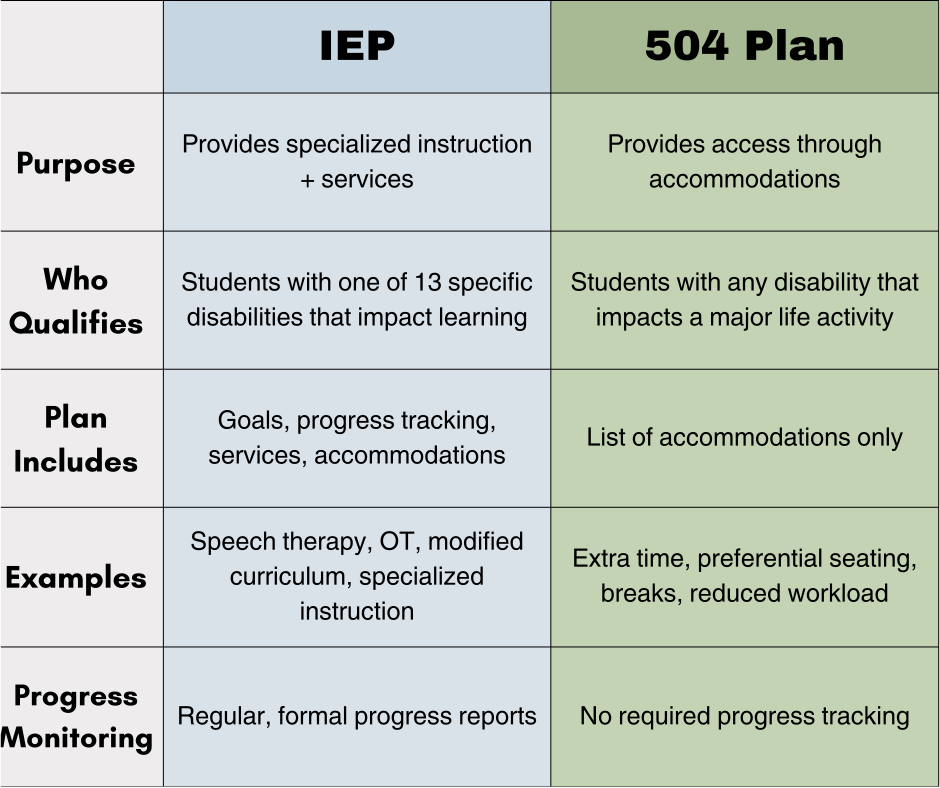
A Real-Life Example
Meet two students: Maya and Jordan. Both are autistic and in the same 3rd grade class.
Maya is autistic and has significant challenges with reading comprehension, sensory processing, and communication. Her autism substantially impacts her ability to learn at grade level without specialized instruction. Maya qualifies for an IEP. Her IEP includes specialized reading instruction, speech therapy twice a week, and sensory accommodations.
Jordan is autistic and learns well in a general education classroom but struggles with sensory overload and processing speed on timed tests. Jordan qualifies for a 504 Plan. His plan includes extended test time, a sensory break schedule, and permission to use noise-canceling headphones.
Both kids are getting what they need, it just looks different for each of them.
6. What If You Disagree With the School?
You are a legal member of your child's IEP team, not a passive observer. That means you have the right to disagree, push back, and formally dispute decisions you believe are wrong. If something does not feel right, trust that instinct and know that the law is on your side.
Here are the main options available to you when you and the school are not on the same page.
Start by Putting It in Writing
Whatever your concern, whether it is the evaluation results, the services offered, the placement decision, or the IEP goals - document it in writing. Send a letter or email to the school clearly stating what you disagree with and why. This creates a paper trail and signals to the school that you are serious. Keep copies of everything.
Request an Independent Educational Evaluation (IEE)
If you disagree with the school's evaluation of your child, you have the right to request an Independent Educational Evaluation (IEE), an assessment conducted by a qualified professional outside the school district. Under IDEA, the school must either pay for the IEE or file for a due process hearing to prove their own evaluation was appropriate. You do not need to accept the school's findings as the final word.
Request Mediation
Mediation is a voluntary, confidential process where you and the school meet with a neutral third party to try to resolve the disagreement. It is free to families and is often faster and less adversarial than a due process hearing. Many disputes are resolved at this stage. The school cannot use your agreement to mediate as a reason to delay or deny services.
Request a Due Process Hearing
A due process hearing is a formal legal proceeding where an impartial hearing officer reviews the dispute and makes a binding decision. This is the most powerful tool available to parents, but also the most time-consuming and complex. Read more about due process in this in-depth guide.
⚠️ Know This Before You Disagree
When you sign the IEP, you are consenting to the services listed, but you are not waiving your right to disagree later. You can consent to some parts of an IEP and not others. You can also withdraw consent for services at any time. If you are unsure, ask the school for more time before signing - you are never required to sign on the spot.
🌟 Bonus Tip: You Don't Have to Navigate This Alone

IEP meetings, 504 evaluations, and special education law can feel overwhelming - especially when you're also parenting a child who needs your full attention and energy. That's where working with an autism coach and special education advocate can make a real difference.
At Grow Autism Coaching, we help parents understand their rights, prepare for IEP meetings, advocate effectively, and build strategies that support their child at school and at home.
If you're not sure where to start, schedule a free consultation call. You don't have to figure this out alone.
8. What Happens After High School?

This is one of the most important conversations in special education planning, and one that catches many families off guard. Here is what you need to know about what happens to your child's supports and rights once they leave K–12.
IEPs and 504 Plans End at High School. When your child graduates from high school, or turns 22, whichever comes first - both their IEP and 504 Plan end. IDEA, the law that governs IEPs, only covers students through K–12. And while Section 504 is a broader civil rights law, the formal 504 Plan document created by the school does not usually carry forward either.
⚠️ The Most Important Mindset Shift: The goal of K–12 special education is to help your child succeed. The goal of the laws that apply after high school is only to ensure equal access, success becomes the student's responsibility. That is a significant change and preparing for it takes intentional planning.
How Your Child Can Still Access Accommodations After Graduation
Even though IEPs and 504 Plans end, your child's right to accommodations does not disappear. Two federal laws continue to protect them: Section 504 of the Rehabilitation Act and the Americans with Disabilities Act (ADA). These civil rights laws apply to virtually all colleges, universities, and most employers. They give your child the right to request reasonable accommodations as an adult.
The key difference is that after high school, your child must initiate the process themselves. In K–12, the school is required to identify students who need support. After graduation, no one comes looking. Your child must self-disclose their disability, provide documentation, and make the request. This must happen at every new institution and every new employer.
What Colleges and Employers Actually Need
Whether your child had an IEP, a 504, or neither, here is what they will need to request accommodations after high school:
- Current documentation of their diagnosis: an old school plan alone will not be sufficient
- Self-disclosure: your child must come forward and identify themselves as having a disability, no one will seek them out
- A clear understanding of what accommodations they need: your child will need to ask for specific accommodations. Colleges and employers will approve what they consider "reasonable".
- Patience with re-requesting: college accommodations typically must be renewed each semester or academic year, they do not automatic transfer
The Most Valuable Thing You Can Do Before Graduation
More than any document or paper trail, the single most powerful thing you can do is prepare your child to self-advocate. Help them understand their own diagnosis. Help them know what accommodations make a real difference for them and practice with them what it sounds like to ask for help.
For some autistic young adults, self-advocacy will come naturally with guidance and practice. For others, depending on your child's level of support needs, you may still need to be an active advocate. This can look like helping them navigate the disability services process, accompanying them to meetings, or working directly with the institution on their behalf. Know your child, and plan accordingly.
Either way, the goal is the same - making sure your child enters adulthood with their needs documented, understood, and ready to be communicated. That skill, or support system, will serve them in college, at work, and throughout their entire life.
📋 Transition Planning Reminder: Under IDEA, transition planning must begin by age 16. If your child has an IEP and is approaching high school, ask the team: What is the plan for life after graduation? This should include goals around college, employment, independent living, and self-advocacy. If it is not already in the IEP, request it.
Knowledge Is Your Superpower
Here is the truth: the special education system can be hard to navigate. The jargon is confusing and the meetings can feel intimidating. But now you know the four pillars of your child's educational rights.
IDEA creates the legal foundation
FAPE is the guarantee
IEP delivers specialized instruction and services
The 504 Plan removes barriers to access
All four work together to protect your child's right to a meaningful education, at no cost to your family.
Understanding these terms helps you walk into every school meeting with confidence, ask the right questions, and push back when something is not right.
Your child deserves an advocate who knows their rights and that advocate is you. If you want support along the way, schedule a free consultation call. Grow Autism Coaching is here to help.
Frequently Asked Questions (FAQs)
Q: Can my child have both an IEP and a 504 Plan?
Typically, no. If your child qualifies for an IEP, that plan already includes all the accommodations and services they need - so a separate 504 Plan is not necessary.
Q: Does my child's autism diagnosis automatically mean they qualify for an IEP?
No, an autism diagnosis alone does not guarantee IEP eligibility. The school must evaluate your child and determine if their disability adversely affects their educational performance and that they need specialized instruction.
Q: How often is an IEP reviewed?
By law an IEP must be reviewed at least once per year. However, you can request a meeting at any time if your child's needs change. A full reevaluation of eligibility must happen at least every three years, though you can request one sooner.
Q: What is the Least Restrictive Environment (LRE) and how does it affect my child?
LRE means that children with disabilities should be educated alongside non-disabled peers as much as possible. Schools cannot place your child in a separate special education classroom just because it is easier, they must justify any removal from general education. Read more about LRE here.
Q: What if I disagree with the school's IEP or evaluation?
You have several options: you can request a meeting to discuss your concerns, request an independent educational evaluation (IEE), seek mediation, or file a formal complaint with your state's Department of Education. You can also request a due process hearing.
Published on growautismcoaching.com | Free Consultation here!
